

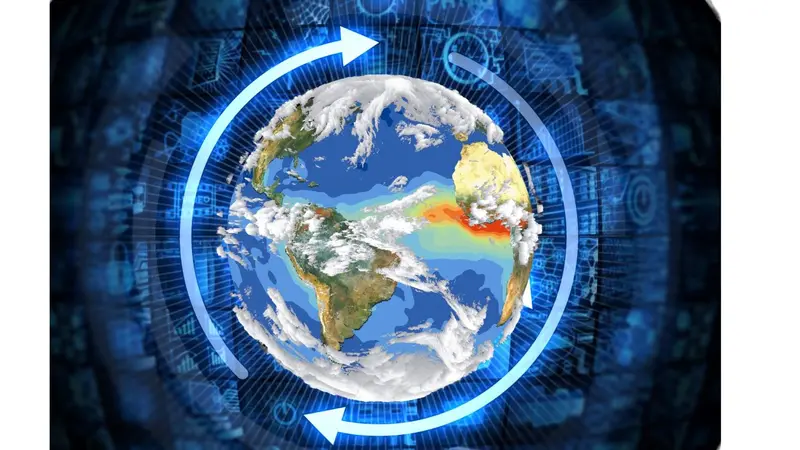

Globe with arrows indicating rotation
alengo from Getty Images Signature/NASA from NASA CCO Images/CanvaPro

Planet and People Connection

Journal Abstracts
May 03, 2025

Planet and People Connection

Climate Change Impacts on Earth’s Rotation

Journal Abstracts
Feb 01, 2026

A 24-hour day seems like a constant, but a day has slowly been getting longer. A day was less than 19 hours long 1.4 billion years ago and was only 23 hours long when dinosaurs roamed the Earth. Natural events such as earthquakes, volcanoes, tides and wind patterns can affect how fast or slow the world turns.

Recently, scientists observed that the dynamics of the Earth’s liquid outer core were causing the planet to speed its rotation, suggesting that we might need to delete a second of time from our clocks for the first time ever. In our highly connected world that relies on precise timekeeping, losing a second could lead to unforeseen complications. However, a new study in the journal Nature concludes that the redistribution of water caused by the melting polar ice caps caused by climate change will delay the need to delete a second from the clock to 2028 or 2029.


REFERENCES
Advanced Search on this topic

Other Articles in this category

Dec 03, 2025 | Planet and People Connection
For decades, sustainability has focused on meeting the needs of the present without limiting the ability of future generations to meet their own…
Oct 31, 2025 | Planet and People Connection
by Ruth Roberts, DVM, CVA, CVH, CVFT, NAN Virtual care, including online consultations with licensed veterinarians and wellness professionals, has…
Oct 31, 2025 | Planet and People Connection
The Thanksgiving table offers a feast of our favorite dishes to share with loved ones, but this annual gathering can lead to food waste, increased…
Aug 29, 2025 | Planet and People Connection
  Families that rely on single-use plastics and prepackaged foods for their children’s lunches often overlook the tremendous amount of daily waste…

Customer Service

KnoWEwell News Updates