


Mental and Behavioral Well-Being
Mental and Behavioral Well-Being
Meditative Scuba Protocol For PTSD
 By
By
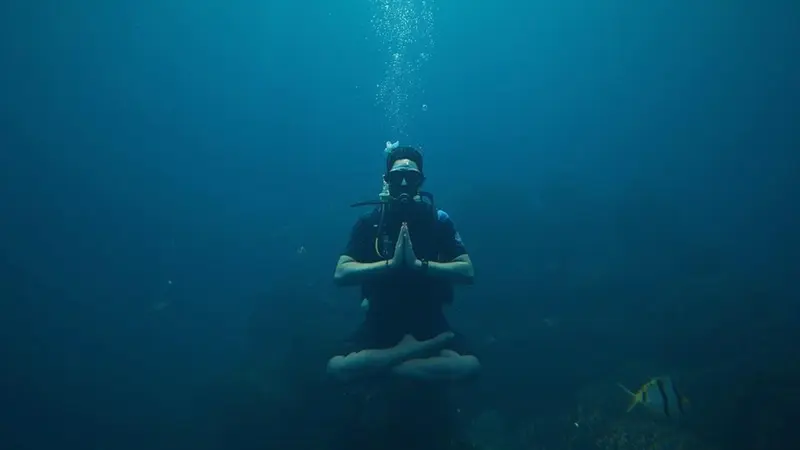
Post-traumatic stress disorder (PTSD) is a long-term and disabling condition for which no single treatment works for everyone. Complementary methods such as exercise, relaxation, and meditation may help reduce symptoms. Scuba diving, which combines physical activity and mindful awareness, has been shown to improve chronic stress and PTSD symptoms.
A pilot study published in the European Journal of Psychotraumatology tested a special form of meditative scuba diving called the Bathysmed protocol, comparing it to a regular multisport program in 34 people who developed PTSD after the Paris terrorist attacks in November 2015. Participants were randomly assigned to either the Bathysmed group or a non-specific multisport program.
The Bathysmed approach includes psychoeducation about stress, breathing, and diving physiology to reduce anxiety and build confidence. It is progressive, involving three stages across ten dives: the first four focus on staying present and reconnecting with bodily sensations, the next four are contemplative and help participants visualize their future differently, and the final two aim to build confidence and encourage letting go.
After one month, participants in the Bathysmed group showed greater improvement in PTSD symptoms—especially intrusive memories—than those in the multisport group, though not all results were statistically significant. The benefits faded after three months, suggesting that long-term mindfulness practice may be needed to maintain improvement.
REFERENCES
Gibert, L., Coulange, M., Reynier, J. C., Le Quiniat, F., Molle, A., Bénéton, F., Meurice, V., Micoulaud, J. A., & Trousselard, M. (2022). Comparing meditative scuba diving versus multisport activities to improve post-traumatic stress disorder symptoms: a pilot, randomized controlled clinical trial. European journal of psychotraumatology, 13(1), 2031590. https://doi.org/10.1080/20008198.2022.2031590