


Natural
Natural
Bison Meat: Health, Ecology, and History
 By
By
By Hannah Tytus
Interest in bison meat has grown steadily in the United States, driven by concerns about cardiovascular health, environmental sustainability, animal welfare, and the ethics of industrial food systems. Interest in bison meat has accelerated rapidly since 2017, as reflected in U.S. Department of Agriculture production data. For tens of thousands of years, bison were a central food source for Indigenous peoples across North America, supporting complex ecological, economic, and spiritual ways of life.
Bison Meat and Human Health
From a nutritional perspective, bison has attracted attention as a lean red meat that offers several benefits over other, more popular animal proteins. According to the United States Department of Agriculture’s National Nutrient Database, bison contains less cholesterol and fewer calories than beef. Bison is nutrient-dense, providing high levels of iron and vitamin B12; its iron content exceeds that of beef, pork, chicken, and salmon, while its B12 content surpasses that of beef, pork, and chicken.
Bison is a lower fat alternative to beef, containing just 2.4 grams of total fat per 3.5-ounce serving, compared with more than 18 grams in the same serving of beef. Beyond having less fat overall, bison also offers a healthier fat profile, particularly when the animals are range-fed. According to Dr. E.W. Askey, a professor of nutrition at the University of Utah, bison contains higher proportions of beneficial fats such as polyunsaturated and omega-3 fatty acids, along with slightly higher levels of conjugated linoleic acid (CLA). CLA is a naturally occurring, beneficial fat that may help reduce inflammation and lower the risk of certain cancers. While eating bison alone is unlikely to supply enough CLA to produce strong effects, it can still meaningfully contribute to overall dietary intake of this potentially protective fatty acid. Together, these factors are associated with a lower risk of heart disease and reduced metabolic stress on the body after meals.
Clinical evidence suggests these compositional differences may translate into measurable health effects. In a 2013 randomized crossover study, healthy men consumed either bison or beef as a single meal and then regularly over a seven-week period. Researchers assessed blood lipids, markers of inflammation and oxidative stress, and vascular function. After beef consumption, participants experienced larger increases in triglycerides, greater oxidative stress, elevated inflammatory markers, and temporary impairment of blood vessel function. These deleterious effects were smaller or absent following bison consumption. Over the seven-week intervention, regular beef intake increased several markers associated with cardiovascular disease risk and impaired vascular function, while bison meat did not produce these negative changes.
These findings indicate bison’s promise as a healthier meat option than beef. Bison meat is mild and slightly sweet rather than gamey, making it a tasty substitute for beef in many culinary contexts.
Bison as a Keystone Species and Ecological Actor
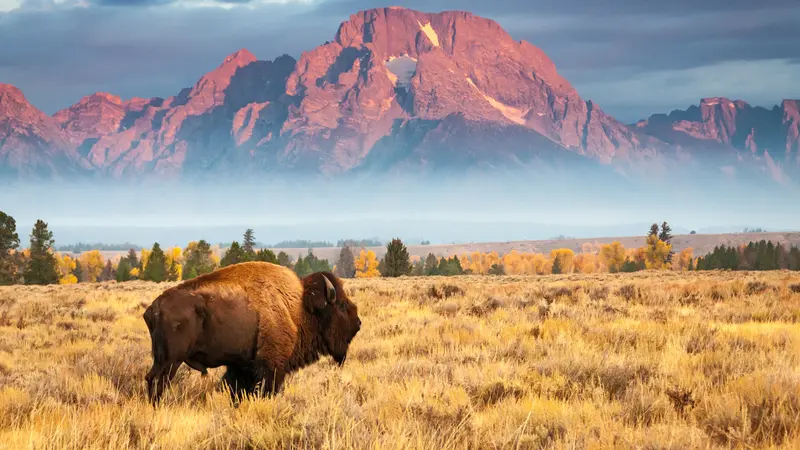
Archaeological evidence shows that this hearty animal once roamed North America in vast herds numbering in the millions, stretching from the Gulf of Mexico to Alaska, and from the Appalachian Mountains to California. They are a native keystone grazer that evolved alongside North American grasslands, meaning that their presence significantly shaped plant diversity, soil structure, and habitat for birds and other species across the continent.
Unlike cattle, bison were never domesticated and are typically raised in extensive pasture systems that resemble their historical ecological role. Organizations such as the National Bison Association emphasize that bison grazing supports grassland regeneration, seed dispersal, and soil health. While bison production is not inherently low impact, their biology and management often align more closely with regenerative land use than conventional feedlot beef systems. Importantly, economic incentives in bison ranching favor minimal handling and open pasture, since excessive confinement or intervention compromises animal health and meat quality.
Compared with industrial beef production, bison systems often involve lower animal density, fewer energy inputs, and greater alignment with natural grazing behavior. While bison ranching is not a universal solution to the environmental harms of meat production, their ecological role highlights how food systems can function better when shaped by place and evolutionary history.
A long-term ecological study led by Kansas State University scientists used over three decades’ worth of prairie data to examine biodiversity in the grasslands. They found that reintroducing native bison dramatically enhanced plant biodiversity and resilience in tallgrass prairie ecosystems. Compared to ungrazed plots, year-round bison grazing roughly doubled native plant species at local and landscape scales and maintained those gains through one of the driest decades in four decades, indicating greater ecological resilience under an extreme drought. Domestic cattle grazing also increased plant diversity relative to no grazers, but to a lesser extent than bison. The authors concluded that the historical loss of bison likely reduced plant biodiversity across the Central Great Plains and that restoring native megafauna could help recover more diverse and stable grassland communities under future environmental change.
Historical Context and Near-Extinction
"Oh give me a home where the buffalo roam," sang Gene Autry in Home on the Range, harkening back to a time in the not-so-distant past where bison (also called buffalo) used to wander the plains of North America in a shifting black sea. Captain Meriwether Lewis—on his expedition with partner William Clark—wrote in his captain’s log that "the whole face of the country was covered with buffalo."
It is estimated that 30 to 60 million bison roamed North America in the early nineteenth century. For Plains tribes, bison were central to foodways, spiritual practices, governance, and social organization. Nearly every part of the animal was used, and hunting and distribution reinforced values of generosity, reciprocity, and collective responsibility. These relational systems sustained not only material life, but health, social cohesion, and spiritual meaning. In many traditions, bison embody life itself, representing a reciprocal relationship between humans and the land.
But as European settlers pushed westward in the late 1800s, the bison’s once-expansive range shrank dramatically. The transcontinental railroad, built between 1867 and 1883, cut directly through core bison habitat, fragmenting herds and accelerating their destruction. Relentless commercial and military-supported hunting soon followed, reducing the population to roughly 1,000 animals by 1883. By the turn of the twentieth century, fewer than 500 remained.
Modern Revitalization and Food Sovereignty
With increasing interest in bison meat and conservation, there is hope for a resurgence of this mighty creature. Today, nearly 400,000 bison live in North America, many within tribal nations or conservation herds. Tribal bison restoration initiatives are increasingly framed as acts of food sovereignty, cultural renewal, and ecological repair. Organizations such as the Tanka Fund support the return of bison to Native lands as a means of restoring traditional diets, strengthening local economies, and improving health outcomes.
Bison meat sits at the intersection of nutrition science, ecological systems, and historical justice. Evidence suggests it is healthier for people and planet, offering a leaner red meat option with fewer adverse cardiometabolic effects than beef, while supporting grassland health and animal welfare. More fundamentally, the return of bison challenges dominant food systems by re-centering Indigenous knowledge, land relationships, and values of reciprocity in the food chain. As interest in bison grows, it offers an opportunity not merely to change what is eaten, but to reconsider how health, history, and responsibility are intertwined.
REFERENCES
Dachev, M., Bryndová, J., Jakubek, M., Moučka, Z., & Urban, M. (2021). The Effects of Conjugated Linoleic Acids on Cancer. Processes, 9(3), 454. https://doi.org/10.3390/pr9030454
Evans, N. P., Misyak, S. A., Schmelz, E. M., Guri, A. J., Hontecillas, R., & Bassaganya-Riera, J. (2010). Conjugated linoleic acid ameliorates inflammation-induced colorectal cancer in mice through activation of PPARgamma. The Journal of nutrition, 140(3), 515–521. https://doi.org/10.3945/jn.109.115642
McDaniel, J., Askew, W., Bennett, D., Mihalopoulos, J., Anantharaman, S., Fjeldstad, A. S., Rule, D. C., Nanjee, N. M., Harris, R. A., & Richardson, R. S. (2013). Bison meat has a lower atherogenic risk than beef in healthy men. Nutrition Research, 33(4), 293–302. https://doi.org/10.1016/j.nutres.2013.01.007
Memorial Sloan Kettering Cancer Center. (n.d.). Conjugated linoleic acid. MSKCC. https://www.mskcc.org/cancer-care/integrative-medicine/herbs/conjugated-linoleic-acid
National Bison Association. Bison: Regenerative by nature. https://nationalbison.org/bison-regenerative-by-nature/. Retrieved January 2026.
National Park Service. Bison bellows. https://www.nps.gov/articles/bison-bellows-1-7-16.htm. Retrieved January 2026.
Sheridan, P. H. (1881, October 13). Letter to Adjutant General (Box 29, Sheridan Papers).
Tanka Fund. History of the Buffalo Nation. https://www.tankafund.org/history-of-buffalo-nation. Retrieved January 2026.
Thornton, R. (1987). American Indian holocaust and survival: A population history since 1492. University of Oklahoma Press.
United States Bureau of the Census. (1890). Eleventh census of the United States. [Retrieved 2026].
United States Department of Agriculture, National Agricultural Statistics Service. (2026). Bison statistics. https://www.nass.usda.gov/Statistics_by_Subject/result.php?6B8E6CBA-37F0-3175- 9643025E2D990731§or=ANIMALS%20%26%20PRODUCTS&group=SPECIALTY&comm=BISON
United States Department of Agriculture, Agricultural Research Service. (2024). FoodData Central: Bison. https://fdc.nal.usda.gov/food-search?type=Foundation&query=bison
University of Utah, Division of Nutrition. (n.d.). Bison – a “healthy” red meat?? National Buffalo Foundation. Retrieved January 23, 2026, from https://www.nationalbuffalofoundation.org/wp-content/uploads/2020/02/University-of-Utah-Bison-Lipid-Study.pdf
University of Utah. Bison lipid study [PDF]. https://www.nationalbuffalofoundation.org/wp-content/uploads/2020/02/University-of-Utah-Bison-Lipid-Study.pdf
Ratajczak, Z., Collins, S. L., Blair, J. M., Koerner, S. E., Louthan, A. M., Smith, M. D., Taylor, J. H., & Nippert, J. B. (2022). Reintroducing bison results in long-running and resilient increases in grassland diversity. Proceedings of the National Academy of Sciences of the United States of America, 119(36), e2210433119. https://doi.org/10.1073/pnas.2210433119