



WELLthier Living and Aging
WELLthier Living and Aging
Humidifier Hygiene for Safe Indoor Air
 By
By
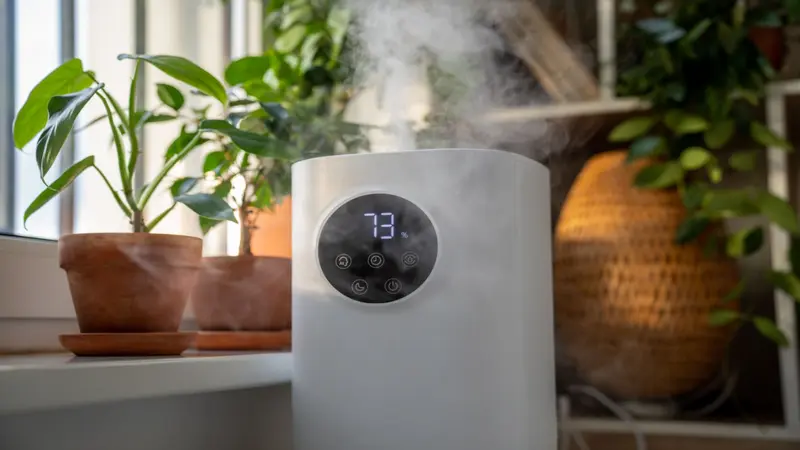
Humidifiers are commonly used in homes during the winter months to add moisture to the dry air and alleviate symptoms like dry nose, throat, lips and skin. However, not all humidifiers are created equally. Several studies have shown that ultrasonic and impeller (or cool mist) humidifiers can disperse microorganisms and heavy metals present in the water into indoor air. These materials can be inhaled through the respiratory system and potentially cause inflammation in the lungs and other adverse health effects.
Types of Humidifiers
There are several kinds of humidifiers.
LESS SAFE: Humidifiers that tend to produce the highest dispersions of microorganisms and minerals
- Ultrasonic humidifiers: create a cool mist using ultrasonic sound vibrations.
- Impeller humidifiers (cool mist): generate a cool mist through a high-speed rotating disk.
MORE SAFE: Humidifiers that can support microorganism growth in standing water, but generally disperse fewer pollutants into the air
- Evaporative humidifiers: add invisible moisture to the air by blowing it through a moistened absorbent material, such as a wick, belt, or filter.
- Steam vaporizers: heat water with an electrical element or electrodes to produce steam. Warm mist humidifiers are a type of steam vaporizer in which the steam is cooled before release.
Evaporative and steam vaporizer humidifiers are not expected to release significant amounts of minerals into the air.
Reducing Toxin Risk
The U.S. Environmental Protection Agency offers these tips for keeping air safe during the winter months:
- Clean the humidifier regularly to reduce potential exposures from bacteria and mold. Pay extra attention to care and maintenance if using ultrasonic or impeller humidifier. Empty the tank, wipe all surfaces dry and refill the water in portable humidifiers daily to reduce any growth of microorganisms.
- If using an evaporative humidifier, pay special attention to the absorbent layer (wick, filter, belt). This component must be thoroughly dried between each use, and replaced semi-regularly to avoid mold growth.
- Follow the manufacturer's suggestions on the use of cleaning products or disinfectants. In the absence of specific recommendations, clean surfaces coming in contact with water with a 3% solution of hydrogen peroxide.
- Fill the humidifier with water that has a lower mineral content, such as distilled water.
- Do not humidify to indoor relative humidity levels exceeding 50%. Higher humidity levels may encourage the growth of biological organisms in the home. Hygrometers, available at local hardware stores, may be used to measure humidity levels.
REFERENCES
-
U.S. Environmental Protection Agency. (n.d.). Use and care of home humidifiers [Fact sheet]. https://www.epa.gov/indoor-air-quality-iaq/use-and-care-home-humidifiers epa.gov+1
-
U.S. Environmental Protection Agency. (n.d.). Indoor air facts no. 8: Use and care of home humidifiers (PDF).