

Healing Ways
Healing Ways
Clinical Trial Shows Singing Bowls Help Anxiety
 By
By
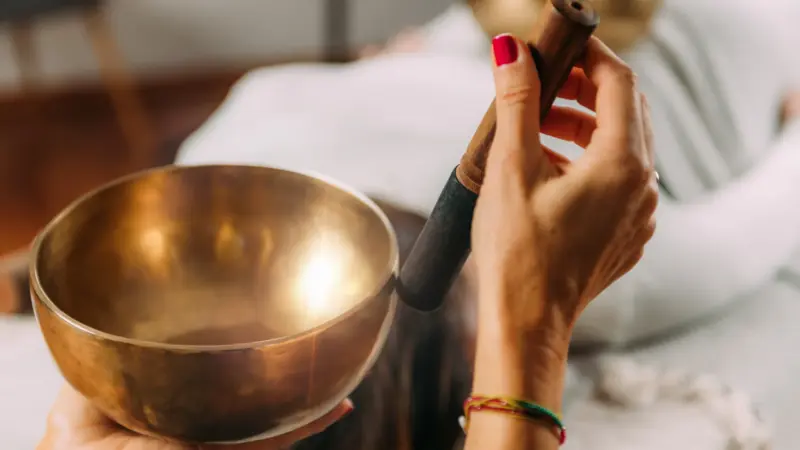
This study tested whether a single session with a Tibetan singing bowl could help people feel calmer compared with two other options: progressive muscle relaxation (a standard relaxation technique where people tense and release muscles) and a control group that simply waited without doing anything.
Researchers recruited 50 adults who did not have an anxiety disorder but were experiencing high anxiety in the moment. Participants were randomly placed into one of the three groups. Each person had four types of measurements taken across the 45-minute session:
- Self-reported anxiety (how anxious they felt)
- EEG, a test that tracks brainwave patterns
- Heart rate variability (HRV), a measure of how well the nervous system adapts to stress
- Standard baseline data before the session began
The singing bowl group showed the strongest physiological signs of relaxation. Their brain activity shifted in a way associated with calmness, and their HRV increased, which typically indicates the body is moving into a relaxed, restorative state. Both the singing bowl and the muscle relaxation groups reported feeling less anxious than the control group, but the singing bowl group experienced the biggest drop.
Overall, the study suggests that even one short session with a Tibetan singing bowl can create measurable psychological and physical relaxation. The authors note that this kind of sound-based session may be useful during stressful events, crisis situations, or while someone is waiting to receive more traditional mental health support.
REFERENCES
Rio-Alamos, C., Montefusco-Siegmund, R., Cañete, T., Sotomayor, J., & Fernandez-Teruel, A. (2023). Acute relaxation response induced by Tibetan Singing bowl sounds: a randomized controlled trial. European Journal of Investigation in Health Psychology and Education, 13(2), 317–330. https://doi.org/10.3390/ejihpe13020024