

Food, Farming and Nutrition
Food, Farming and Nutrition
Cacao, Cocoa and Chocolate: What Is the Difference?
 By
By
The word cacao originates from the Nahuatl term cacahuatl, meaning bitter water, which referred to the original cacao-based drink consumed in Mesoamerica by inhabitants of the Aztec Empire. Among the Maya—an even older civilization in Central America—cacao pods from the cacao tree were ground and mixed with water to create a bitter beverage, lightly frothed from cacao fat and consumed without sugar. This beverage was regarded as sacred. Archaeological evidence, including carvings on Mayan pottery, depicts women grinding cacao on stone metates and frothing the drink, underscoring its ceremonial and cultural significance long before Spanish colonial contact.
When Spanish colonizers began extracting from the Americas, cacao was introduced to Europe and the Spanish adapted both the drink and its name. Rather than adopting the then-current Aztec word cacahuatl (xocolātl), which carried awkward phonetic associations in Spanish, they adapted the sounds to suit their language. This linguistic shift gave rise to the word chocolate, while the sweeter preparation that emerged in Europe reflected the addition of sugar and other ingredients. The word cocoa developed later as an anglicized variation of the Spanish cacao, representing a linguistic drift rather than a distinct substance.
Same Plant, Different Processing
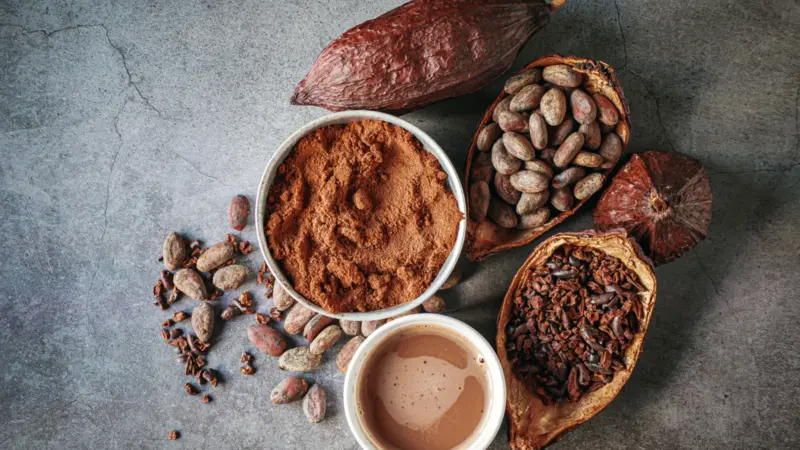
Cacao, cocoa and chocolate all come from the same plant, Theobroma cacao, but they differ significantly in how they are processed. These differences affect flavor, nutrient content and potential health benefits. Within the craft chocolate and wellness industries, cacao is often used to signal higher quality, minimal processing, or authenticity. This framing draws on the term’s association with Latin American origins and Indigenous knowledge systems.
Cacao refers to the least processed form of the cacao bean. After harvesting and fermentation, cacao beans are typically cold-pressed or minimally processed and are not roasted at high temperatures. Products like raw cacao powder, cacao nibs and cacao paste usually contain no added sugar or dairy. Because cacao is exposed to less heat, it retains higher levels of naturally occurring compounds such as flavanols, magnesium, iron and theobromine. These compounds are sensitive to heat and processing, which makes cacao the most nutrient-dense option of the three.
Cocoa is made from cacao beans that have been roasted at high temperatures. Roasting deepens flavor and reduces bitterness but also lowers the concentration of beneficial flavanols. Many cocoa powders are additionally alkalized, a process sometimes called Dutch processing, which further reduces acidity and darkens color. This step can significantly decrease antioxidant levels. Unsweetened cocoa powder still contains some minerals and antioxidants, but in much lower amounts compared to minimally processed cacao.
Chocolate is produced by combining cacao or cocoa with other ingredients, most commonly sugar and cocoa butter and sometimes milk and emulsifiers. The nutritional value of chocolate depends heavily on how much cacao it contains. Dark chocolate with a high cacao percentage retains some beneficial compounds, while milk chocolate and white chocolate contain far less. Milk proteins may also interfere with the absorption of cacao flavanols.
Health Benefits and What the Science Shows
Cacao has the strongest evidence for health benefits. Research shows that cacao flavanols can improve blood vessel function, support healthy blood pressure and reduce inflammation. These effects are largely attributed to increased nitric oxide availability, which helps blood vessels relax and improves circulation. Studies have also linked cacao consumption to potential cognitive and mood benefits.
Cocoa can still offer health benefits, particularly if it is non-alkalized. Some studies show modest improvements in blood pressure and antioxidant activity. However the degree of benefit varies widely depending on how the cocoa is processed and many commercial products contain added sugars that reduce overall health value.
Chocolate shows conditional benefits. Large reviews suggest that moderate consumption of dark chocolate is associated with lower cardiovascular risk and improved cholesterol markers. These benefits are most apparent when chocolate is high in cacao content and low in added sugar. Excess sugar intake can offset potential gains, making portion size and product choice important.
REFERENCES
Buitrago-Lopez, A., Sanderson, J., Johnson, L., Warnakula, S., Wood, A., Di Angelantonio, E. (2011). Chocolate consumption and cardiometabolic disorders: Systematic review and meta-analysis. BMJ, 343, d4488. https://doi.org/10.1136/bmj.d4488
Ellam, S., & Williamson, G. (2013). Cocoa and human health. Annual review of nutrition, 33, 105–128. https://doi.org/10.1146/annurev-nutr-071811-150642
Hooper, L., Kroon, P. A., Rimm, E. B., Cohn, J. S., Harvey, I., Le Cornu, K. A., Ryder, J. J., Hall, W. L., Cassidy, A. (2012). Flavonoids, flavonoid-rich foods and cardiovascular risk: A meta-analysis of randomized controlled trials. The American Journal of Clinical Nutrition, 95(3), 740–751. https://doi.org/10.3945/ajcn.111.023457
Katz, D. L., Doughty, K., Ali, A. (2011). Cocoa and chocolate in human health and disease. Journal of the American College of Cardiology, 57(9), 981–1000. https://doi.org/10.1016/j.jacc.2010.07.055
Keith’s Cacao. (n.d.). Ceremonial cacao vs. cocoa powder: What’s the difference and why it matters. https://www.keithscacao.com/blogs/keiths-cacao-blog/ceremonial-cacao-vs-cocoa-powder-what-s-the-difference
Leavens, M. (2020, June 30). Cocoa versus cacao. ReVista: Harvard Review of Latin America. https://revista.drclas.harvard.edu/cocoa-versus-cacao/
Nib and Noble. (n.d.). Cacao vs cocoa: Your ultimate guide. https://www.nibandnoble.com/blogs/news/cacao-vs-cocoa-your-ultimate-guide/
Payne, M. J., Hurst, W. J., Miller, K. B., Rank, C., Stuart, D. A. (2010). Impact of alkalization on the antioxidant and flavanol content of commercial cocoa powders. Journal of Agricultural and Food Chemistry, 58(19), 10518–10527. https://doi.org/10.1021/jf1020242